

令和7年度第16回STPPセミナー
令和7年度第14回STPPセミナー
2025/07/28

発表者:新井 まどか (M2)
発表タイトル: A study of the relationship between REP and plasma waves using Conjunction events and Statistical analysis with ISS/CALET and magnetospheric satellites
要旨: The dynamic variation of the Earth’s radiation belts is a critical theme in space weather research, as it can cause satellite malfunctions and expose astronauts to radiation. Relativistic Electron Precipitation (REP), observed in Low Earth Orbit (LEO), captures the loss process of the radiation belts as MeV-range electrons precipitate into the Earth’s atmosphere. Pitch-angle scattering of electrons through interaction with chorus waves in the high-latitude magnetosphere is a leading mechanism for causing REP. However, because chorus waves tend to deviate from magnetic field lines as they propagate to higher latitudes, it is believed that ducting structures, formed by density gradients, are necessary for them to travel to these regions.
In this study, we compared the generation regions of REP and chorus waves based on conjunction events from the CALorimetric Electron Telescope (CALET) on the ISS and the Arase satellite orbiting the magnetosphere. REP events were defined as cases where the count rate ratio between the two layers of CALET’s Charge Detector (CHD), CHD-X (≥1.5 MeV) and CHD-Y (≥3.5 MeV), was 1.2 or greater. For chorus waves that coincided with the presence of density gradients, we conducted ray-tracing simulations assuming a ducting structure. Furthermore, we investigated the generation period of individual chorus elements using waveform data from Arase’s Waveform Capture (WFC), which samples at 64 kHz. Similarly, we analyzed the millisecond-scale fluctuation periods of REP using high-time-resolution data from the CHD (up to 20 Hz) and compared them with the generation periods of the chorus elements.
Additionally, in this research, we investigated the occurrence distributions of REP events attributed to whistler-mode chorus waves and those attributed to Electromagnetic Ion Cyclotron (EMIC) waves, using CALET data from 2015 to 2025.
In this seminar, we will report on the insights gained from our conjunction events and the results of our statistical analysis.
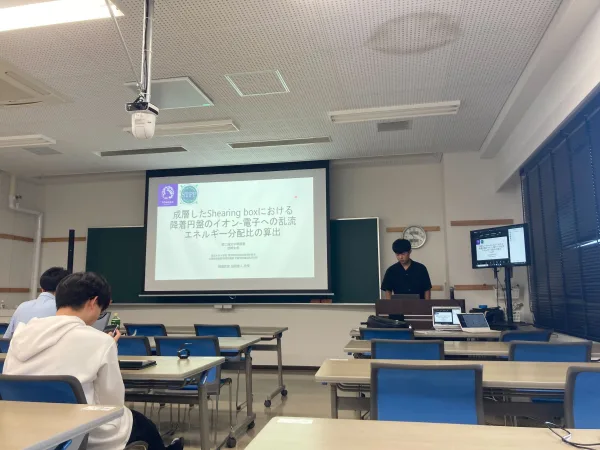
発表者:樫崎 太希(M2)
発表タイトル:Estimation of the Ion–Electron Turbulent Energy Partition Ratio in Stratified Shearing Boxes of Accretion Disks
要旨:Accretion disks are ubiquitously formed around compact objects. The plasma composing these disks accretes onto the central body and, by releasing its gravitational energy, heats the disk and produces X-ray emission. The associated angular-momentum transport and plasma heating are thought to be driven by the magnetorotational instability (MRI; Balbus & Hawley 1991). For the hot, weakly collisional accretion flows surrounding objects such as Sgr A* and M87, the fraction of turbulent dissipation apportioned between ions and electrons plays a central role in the physical interpretation of Event Horizon Telescope (EHT) observations (e.g., Kawazura et al. 2019). However, many previous studies of ion–electron energy partition by turbulence either ignore the disk’s vertical stratification or treat it in a highly simplified manner. Real disks are inevitably stratified by gravity and pressure gradients; in the presence of a horizontal magnetic field, this can trigger the Parker instability. By buoyantly elevating magnetic flux tubes and driving gas motions, this instability may significantly affect the global disk dynamics and energy-transport processes.
The ultimate goal of this work is to incorporate vertical stratification into the theoretical frameworks for MRI-driven turbulent heating proposed by Kawazura et al. (2022) and Satapathy et al. (2024). In this talk, I present a linear analysis of a vertically stratified system that can host the Parker instability, calculate the corresponding eigenfunctions, and evaluate the ion–electron energy-partition ratio. This enables a quantitative assessment of how vertical stratification modifies turbulent heating in accretion disks.